

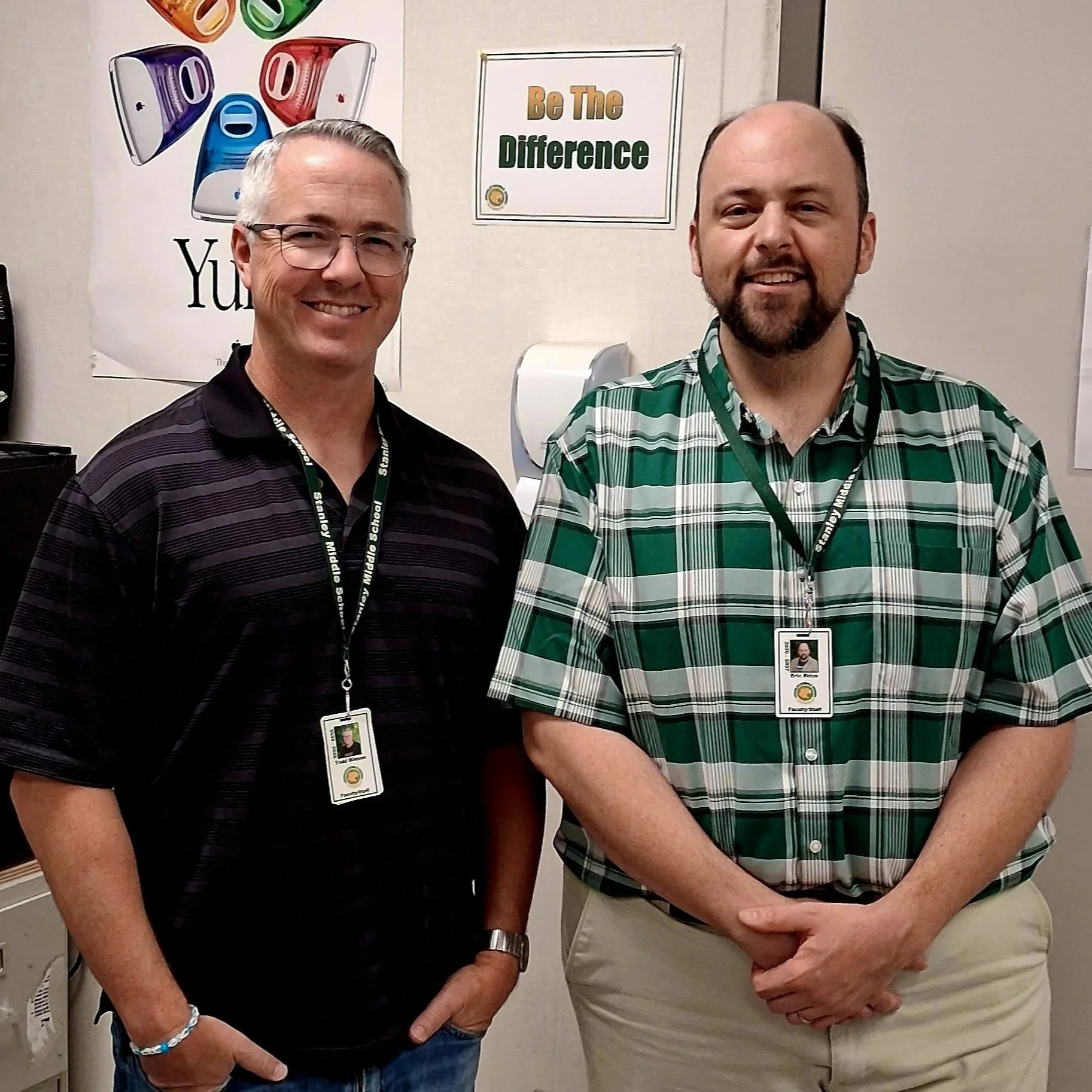
Step into Stanley Middle School’s music rooms and you may hear a band finding its rhythm, an orchestra shaping a passage, or a chorus preparing to perform. At the center of that energy are music teachers Todd Minson and Eric Price, two professional musicians with something else in common: both once sat where their students sit now.
Minson attended Springhill Elementary, Stanley, and Acalanes; Price went through Burton Valley, Stanley, and Acalanes. Though several years apart, they shared some influential teachers. Today, they are carrying forward a Lafayette tradition of music education that reaches far beyond notes on a page.
Inspired here and called back
For Minson, music competed with another childhood passion: baseball. By his senior year at Acalanes, he knew music was his path. Inspired by Arlene Fox, Bob Athayde, and Rick Meyer, he imagined becoming a teacher, though college first led to about 20 years as a professional musician.
Minson later served as an LPIE music mentor alongside his former teacher Athayde. When Athayde prepared to retire, he encouraged Minson to apply. Now in his fifth year at Stanley, Minson leads band and chorus.
Price found his instrument in an unforgettable way. He began piano lessons around age four, but during an elementary-school instrument demonstration, Fox played the bass, and its vibrations shook the floor. Price remembers thinking, “Wait a second. This is something I can do?” The bass became his calling. He studied music at UC Davis, earned a graduate degree from Shenandoah Conservatory of Music, then spent roughly 15 years performing and teaching in the Bay Area.
Price considered classroom teaching when the pandemic interrupted his work as a musician and traveling coach. His former Stanley strings teacher, Loretta McNulty, invited him to substitute as she prepared to retire. He now teaches orchestra and strings.
For both, coming back feels personal. “It’s nice to give back to a community that gave me so much,” Minson said. Their return passes the baton from the teachers who built the program to former students guiding its next generation.
A place to belong and grow
Minson and Price want capable musicians, but technical skill is not the program’s only purpose. Ensembles cultivate teamwork, empathy, discipline, and resilience as students listen closely, accept feedback, and recover from mistakes. As Minson put it, “Music can help you become a better human being.”
Price reminds students that mistakes are a natural and useful part of music class. A difficult measure can be slowed down, separated into smaller skills, and tried again, building confidence that carries into presentations, team projects, and other challenges.
Minson has watched that growth unfold over years. He remembers one student who arrived very shy, playing quietly with her hair covering her face. By the end of eighth grade, she played, spoke, and carried herself with confidence. Music class was not the only reason for that transformation, he said, but it gave her a team and a place to grow. “We’re a team,” he tells students. “We’re here to encourage one another and lift each other up.”
That sense of belonging can mean a great deal in middle school. “Students often tell me this is the bright point of their schedule and their day,” Price said. He hopes they remember creating with friends and entering a room where the difficulties of the day could briefly melt away.
Opportunities that are not guaranteed
Stanley’s program gives students experiences that many young musicians elsewhere never receive. They can participate in band, orchestra, chorus, and before-school jazz, combine ensembles, perform in Wildcats on Stage productions, and bring their own ideas to the program. One student suggestion even led to a pilot ensemble that brought strings and band students together.
Performance opportunities connect students with audiences throughout Lafayette and beyond. Stanley musicians appear at community events such as the Lafayette Reservoir Run and It’s a Wonderful Life, perform for younger students at elementary-school concerts and join neighboring schools at the annual Jazz Cafe. Top ensembles also participate in festivals where adjudicators provide detailed feedback. Whether or not they have children in the schools, Lafayette residents see the results at concerts, celebrations, and traditions where young musicians contribute to the cultural life of the town.
The program’s strength rests on decades of commitment from teachers, families, school and district leaders, community partners, and LPIE. That support helps put school-owned instruments into students’ hands, reducing the chance that cost will determine whether a child can play. Minson has taught where too few instruments forced students to enter a lottery, rent one, or choose something else. At Stanley, access to instruments opens the door for more students to participate fully.
LPIE-funded instrumental instructors and music mentors add another uncommon layer of support. A specialist can take a small group, identify exactly where students are struggling, and offer a practical adjustment that helps them move forward. Meanwhile, the classroom teacher can work more closely with the remaining ensemble instead of asking students to wait while one section receives attention.
Just as important, that individual attention helps students feel seen. A mentor can notice that a student had a hard day, point out what is already going well, and make one frustrating problem feel manageable. Without those instructors, Price explained, the program loses some of the individualized care, flexibility, and encouragement that help beginners move in a positive direction.
Keeping music within every student’s reach
In Lafayette, a program this rich can easily feel like a natural part of school. But, as Price noted, “Music is not guaranteed in most middle schools across the country or even in our state.” Stanley shows what becomes possible through sustained access to the arts and how those benefits continue across generations.
Minson hopes students keep music in their lives, whether professionally, in a community ensemble, or simply at home for the joy of it. Most of all, he and Price hope they leave with happy memories, lasting friendships, and the knowledge that they found a place to create, persevere, contribute, and be heard.